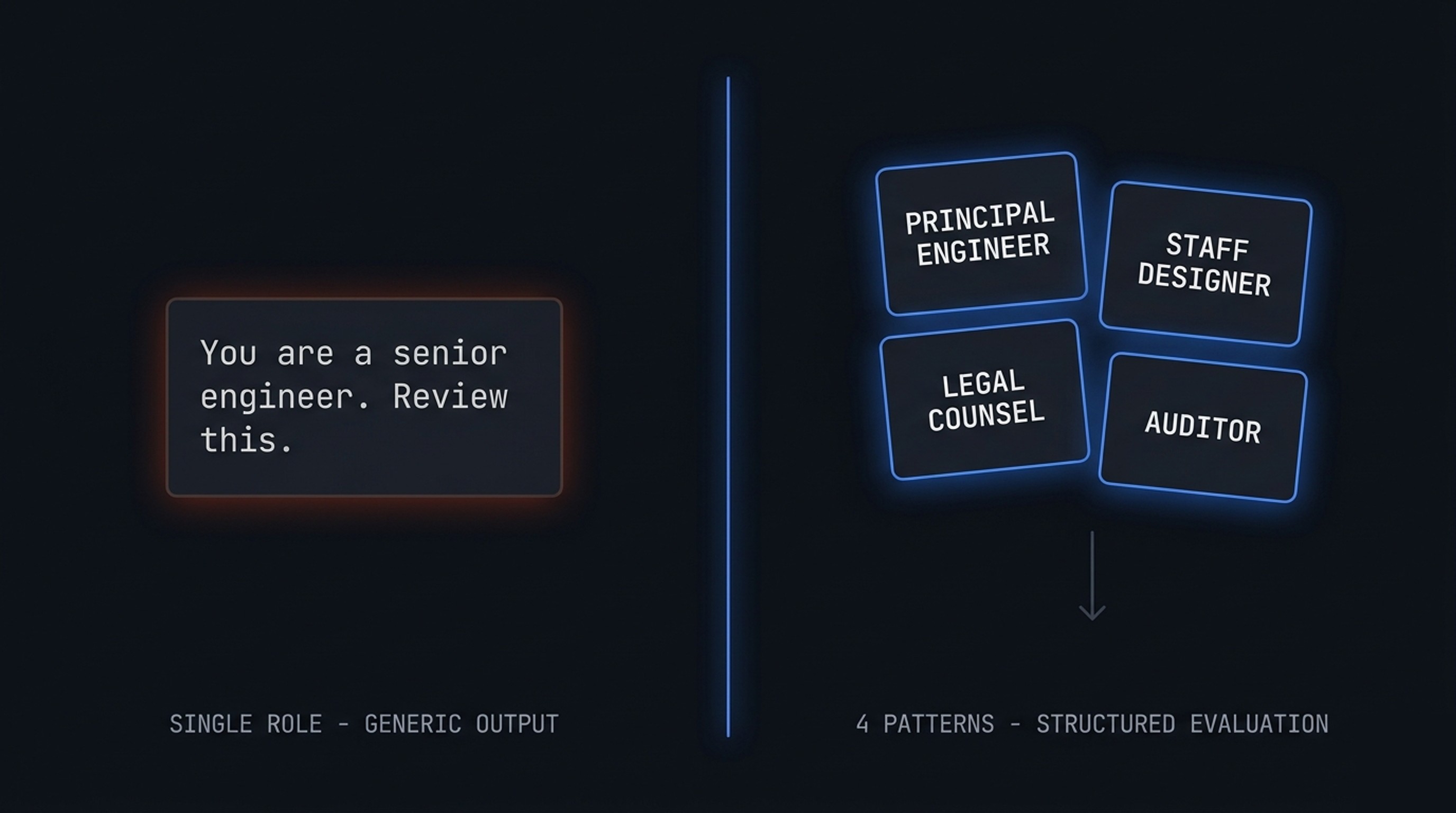
Expert persona prompting - telling an AI it is a world-class engineer, a senior architect, a principal scientist - is the most widely recommended prompting technique and one of the most misunderstood. Used correctly, it compounds. Used wrong, it flatters you while quietly degrading accuracy. Here is a system for using it correctly.
TL;DR - Wharton (2026): expert persona prompting drops factual accuracy by 3.6 points on MMLU benchmarks. Personas change the evaluation lens, not the facts retrieved. The four patterns that do work - Expert Pair, Domain Expert Injection, Hostile Insider, Adversarial Chair - each target a specific failure mode in AI-assisted work. A decision table with failure modes is at the bottom.
1. Why "You Are a Senior Engineer" Underperforms
The prompt is everywhere: "You are a senior engineer. Review this." Major AI providers recommend it. Prompt engineering guides list it as step one. And according to Wharton's Generative AI Labs (2026), it is probably making the output worse.
Their study, Playing Pretend: Expert Personas Don't Improve Factual Accuracy, found that assigning expert personas decreased performance on knowledge-heavy tasks. Models with expert personas scored 68.0% on the MMLU benchmark versus 71.6% without - a 3.6-point drop. Coding task accuracy fell by 0.65 points. Math accuracy fell by 0.10 points.
The mechanism is not mysterious. Telling the model it is an expert does not add any facts to its weights. The persona appears to shift the model's attention toward identity-consistent generation - producing outputs that sound like an expert would produce them - rather than toward accurate knowledge retrieval. The model becomes more confident and less correct.
USC research (published ACL 2026) mapped where persona prompting helps and where it hurts:
- Where it helps: extraction tasks (+0.65), reasoning (+0.40), writing and style tasks (significant positive effect)
- Where it hurts: factual recall, code correctness, mathematical reasoning
The pattern is consistent: personas change the lens through which the model evaluates, not the facts it retrieves. That reframe is the foundation of everything that follows.
2. Role Prompting vs Persona Prompting
Two techniques get conflated constantly. They are different tools.
Role prompting defines what the AI does. It assigns a function: code reviewer, editor, data analyst. The model knows what job it is performing and applies the relevant frame.
Persona prompting defines who the AI is. It adds institutional memory, professional background, and point of view: "the battle-hardened dev who has seen this codebase fail in production twice" is a persona. "The legal counsel who interprets bill statuses for compliance reporting" is a persona. Identity, not function.
Role prompting is stronger for tasks where the job is clear - reviewing, editing, debugging - because it frames the evaluation criteria without interfering with knowledge retrieval. Persona prompting is stronger when you need the model to hold a specific professional mental model, not just a job title.
When not to use either:
- Debugging a specific known error - the model needs to retrieve accurate information, not perform a role
- Factual verification - same reason
- Tasks with a tight, well-defined spec - if you already know what good looks like, a persona adds friction without adding perspective
- Anywhere speed matters more than thoroughness
With that framing established - four patterns that do compound.
3. Live Demo: The Adversarial Chair Applied to This Article
Before explaining Pattern 4, here is what it looks like in practice - applied to this article's own draft. Two adversarial personas were run against an earlier version. Their critiques are condensed but verbatim in substance. The changes they forced are listed explicitly.
Critique 1 - Staff AI Engineer, skeptical, pressed for time:
- The decision table is buried at the end. It is the only thing I would actually use today. Move it up, or at least signal it in the intro.
- You are telling me personas work better. Show me the transcript - even 4 lines of two personas disagreeing. The pattern only clicks when I see the disagreement.
- Six categories is too many. I will remember two. Collapse the Archaeologist and Auditor or tell me the distinction that makes them non-interchangeable.
- The before/after baseline matters. Persona vs nothing is an easy win. Show me persona vs a decent single-role prompt - that is the harder and more honest test.
- No mention of when not to use this. Every tool article that skips that loses my trust in the first section.
Critique 2 - Senior Editor, AI and Tech, Bloomberg:
- "Expert Panel in Your Prompt" is a metaphor, not a headline. Nobody searches for it. Use the actual term: persona prompting. Make the headline searchable.
- The lede buries the finding. If expert persona prompting produces worse outputs on knowledge tasks, that is the first sentence - not the method.
- Six patterns with no hierarchy signals incomplete thinking. Give them a learning curve: entry level and advanced. Tell me where to start.
- No data, no publication. "Better outputs" is a claim. Source it or do not make it.
- The failure mode is the most interesting angle. Lead with when it fails, then show when it works. That is the counterintuitive structure that gets forwarded.
What changed as a result:
- Headline changed from a metaphor to a direct claim backed by the research finding
- Lede opens with the Wharton data - failure mode first
- Six patterns collapsed to four, with an explicit entry-level / advanced split
- The live demo moved to section 3 - before the patterns, not after them
- "When not to use" added to section 2, early
- Five citations added and verified
This is the article that survived those two critics. The patterns below are what remained after the collapse.
4. Pattern 1 - The Expert Pair (Entry Level)
Two roles with genuinely different success criteria, assigned at the start of a session. The engineer asks "is this correct?" The designer asks "would a user understand this in three seconds?" Neither question alone is sufficient. The tension between them surfaces trade-offs that a single-role prompt buries.
You are a principal [framework] engineer.You are a staff UI/UX designer.
[task description]
The engineer should flag correctness issues.The designer should flag anything a user or developerwould misread at first glance.Note explicitly where you disagree.
The last line - "note explicitly where you disagree" - is the upgrade that makes the pattern work. Without it, the model blends the two perspectives into a single diplomatic answer. The disagreement is the signal. It shows you the actual axis of the decision.
Extension: Same Question, Two Chairs. Ask the same question to two personas with different success criteria. The gap between their answers is where the real decision lives.
# Chair 1Take the persona of a CTO at a company with CDN andstatic-deployment constraints.Which of these four chart libraries would you choose, and why?Options: Chart.js, Observable Plot, Recharts, Nivo
# Chair 2 - same question, different frameTake the persona of a Chief Design Officer expert indata dashboard design.Same question. Which would you choose for maximum visual clarity?
In practice: the CTO picked Chart.js - static, CDN-safe, no runtime dependencies, team familiarity. The CDO picked Observable Plot - superior data-ink ratio, composable grammar, FT-quality output. Neither was wrong. The gap revealed the real trade-off axis: deployment constraints versus visual expressiveness. The final choice was Chart.js - but the team now knew what they were giving up. That clarity is what the single-persona prompt cannot produce.
This pattern maps to what arxiv 2311.17371 calls multi-agent debate: multiple LLM instances as distinct expert personas engaging in structured evaluation. The paper found +13% accuracy on reasoning tasks (GPT-4o logic puzzles) when this structure was applied. The key condition: personas must have genuinely different success criteria, not just different titles.
5. Pattern 2 - Domain Expert Injection (Entry Level)
A mid-session switch to a professional whose real-world mental model differs from a developer's. Use this when the feature, UI, or data model will be operated by someone with professional domain knowledge that shapes how they read the same information.
Take the persona of a legal counsel (UK solicitor).
Review this color logic for parliamentary bill statuses.Tell me how a compliance officer would read each statusin practice - not how a developer would interpret the label.
What that prompt produced: the compliance officer reads "Royal Assent" as the only status that means "no action required." Every other status in the parliamentary lifecycle - First Reading, Committee Stage, Report Stage, Third Reading - is still live risk. The developer's color logic (green for positive progress, amber for in-progress) was wrong for the professional's frame. Green means "safe to file and forget." Nothing short of Royal Assent earns that.
The domain expert sees the same data through a professional liability lens, not a UI state machine lens. That is not a perspective the engineer or designer in the Expert Pair would have surfaced.
Scale test extension. Run the same domain persona at different scale to stress test dimensions the first pass misses:
# Pass 1Take the persona of a compliance admin managing50 employees across 6 reporting tiers.Review this org chart UI for how you would use it day-to-day.
# Pass 2Now review it for 200 employees and 10 seniority levels.What breaks first?
Pass 1 finds navigation and labeling issues. Pass 2 finds performance, rendering, and information architecture failures that only appear at scale. Each pass stresses a dimension the first persona would not surface under normal conditions.
6. Pattern 3 - The Hostile Insider (Advanced)
Adversarial intent combined with specific context. Two variants, different applications.
Variant A - The Codebase Archaeologist. For code that has history. The clean-room reviewer gives best-practice advice. The archaeologist gives advice that accounts for why the clean approach will hit a wall at layer 3.
Critique this refactoring plan like the battle-hardeneddeveloper who has worked on this codebase for 10 years.They know which refactors were abandoned and why.They know where the "clean" approach will fail.Variant B - The Auditor. For anything with external exposure - security, compliance, billing, data retention. The modifier is load-bearing.
You are an external security auditor reviewing thisfor a production fintech deployment.Be very unconvinced. Ask many questions to be 100% sure.
If you were auditing this endpoint, where would youlook first? What would you flag in the first 10 minutes?
"Be very unconvinced" is not decorative. Without it, the model defaults to confirming your approach because confirmation is the statistically likely response to a proposal. With it, the model treats the proposal as a hypothesis to be stress-tested. The auditor persona plus that modifier surfaces issues that a standard review never reaches - because a standard review is not looking for failure modes, it is assessing what is already there.
Archaeologist vs Auditor: use the Archaeologist for refactoring legacy systems and architectural decisions in established codebases. Use the Auditor before shipping anything with external exposure or irreversible consequences. They are the same adversarial structure applied to internal risk versus external risk.
7. Pattern 4 - The Adversarial Chair (Advanced)
Structured hostile critique with escalating seniority. Three passes, each catching what the previous missed. This is the formal version of what Anthropic's Constitutional AI paper (2022, arxiv 2212.08073) describes as the Critique-Revise loop - a feedback structure where the model generates a response, critiques it against a principle, and revises. Applied iteratively with escalating critic authority.
# Pass 1 - Competent external reviewerCritique this architecture plan like the CTO of Cloudflare.
# Pass 2 - Hostile insider (after incorporating pass 1 findings)Now critique it like the battle-hardened developer whoworked on this codebase for 10 years.They know where the bodies are buried.
# Pass 3 - Elite bar (after incorporating pass 2 findings)Final pass: Member of Technical Staff at Anthropic,ex-big-tech CTO background. Super critical view.What survives passes 1 and 2 but still has a fundamentalweakness in reasoning or assumption?
Pass 1 finds architectural gaps and technology choices that would not survive peer review. Pass 2 finds what survived pass 1 because the external expert did not know the institutional context. Pass 3 finds what survived both because it requires the highest bar of reasoning critique to surface.
The critical rule: each pass must find different things. If pass 2 repeats pass 1's findings, the personas are not different enough. Escalate the frame - institutional context, elite bar - not just the seniority level.
When not to run three passes: simple tasks with tight deadlines, greenfield work with a clear spec, anything where the cost of being thorough exceeds the cost of being wrong. Three passes is a pre-ship tool for irreversible decisions. It is not the default.
The data point worth sitting with from my own sessions: mid-session switches (51 instances) outnumber both Expert Pair openers (44) and multi-persona stacks (40). I had set the persona once and forgotten it more often than I switched it. The higher-leverage move is switching chairs when the task context changes mid-session - from building to reviewing, from engineering to domain-expert stress-testing, from planning to adversarial critique.
8. Decision Table
| Task | Pattern | Key modifier | Failure mode |
|---|---|---|---|
| New feature or system design | Expert Pair | "Note where you disagree" | Both personas agree - not enough tension in role definitions |
| Architecture or tool decision | Same Question, Two Chairs | Explicitly different success criteria per persona | Personas too similar - gap disappears, one answer emerges |
| Feature used by domain professionals | Domain Expert Injection | Match the specific profession and jurisdiction | Generic "end user" instead of the specific professional role |
| Refactoring legacy or complex systems | Hostile Insider (Archaeologist) | "Knows where the bodies are buried" | Skipping on "simple" changes - the institutional context is always relevant |
| Pre-ship review, security, compliance | Hostile Insider (Auditor) | "Be very unconvinced" | Running it after deploy, not before - the window for the finding is gone |
| Major plan, design, or document | Adversarial Chair | Three-pass escalation with distinct frames | Single pass only - pass 2 catches different things than pass 1 |
A note on my adoption rates. These numbers are personal - audited from my own Claude Code session history, not a controlled study. In my backend API work, I used at least one persona pattern in 65% of sessions. Portfolio and frontend work: 57%. Content and editorial work: 42%. The pattern held in my experience: the lower the rate, the more I was using AI as an autocomplete rather than a structured evaluation tool. Your numbers will differ - but the audit itself is worth running.
The three-pass adversarial chair is the most expensive pattern here. It is slow, it requires revisiting decisions you thought were settled, and it surfaces problems that are genuinely uncomfortable to fix.
Which current decision in your work is expensive enough to warrant it - and which ones are you running single-pass because it feels like the faster option? 👇
Sources:
- Wharton GAIL (2026) - Playing Pretend: Expert Personas Don't Improve Factual Accuracy
- arxiv 2603.18507 - Expert Personas Improve LLM Alignment but Damage Accuracy (PRISM, 2026)
- ACL 2026 - Persona Prompting as a Lens on LLM Social Reasoning
- arxiv 2311.17371 - Should We Be Going MAD? Multi-Agent Debate Strategies for LLMs
- Anthropic (2022) - Constitutional AI: Harmlessness from AI Feedback
Working through the challenges in this post? I help engineering leaders and CTOs navigate complex technical decisions and scale high-performing teams. Schedule a consultation →