The World Economic Forum's Future of Jobs Report 2025 projects that 39% of workers' core skills will need to change by 2030 — disrupted primarily by AI and automation. But almost nobody talks about what happens to the people affected by it.
The Automation Win (On Paper)
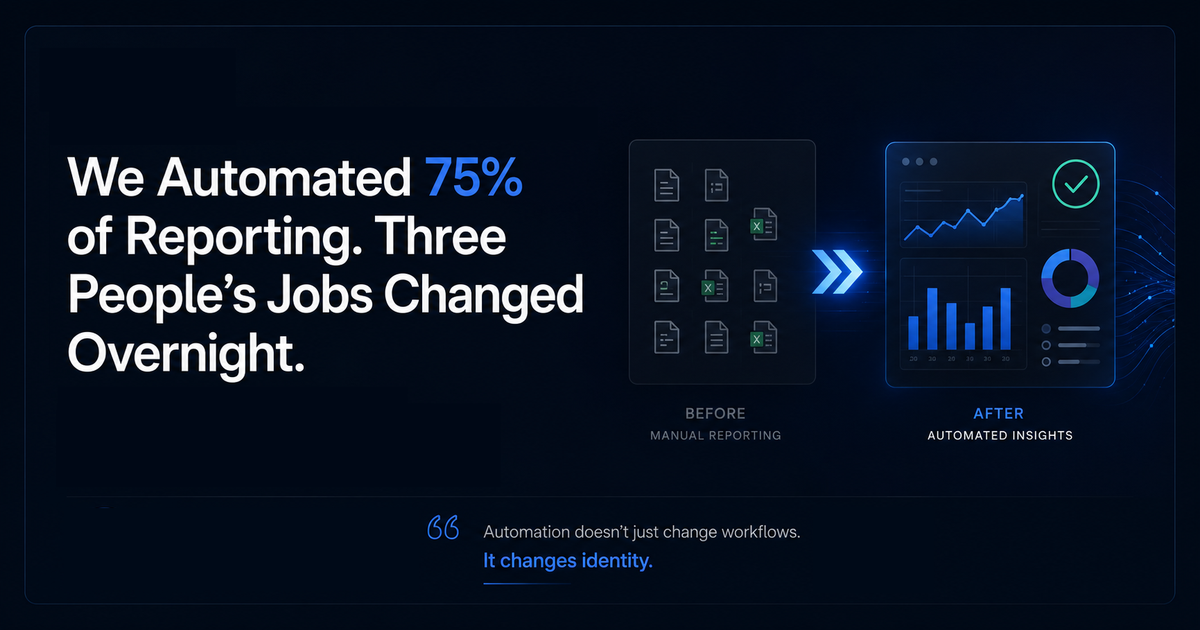
We automated ~75% of manual reporting.
What used to take 3 analysts an entire week every month became daily, automated refreshes.
Before:
- Data pulled manually from all systems
- Constant reconciliation issues
- Conflicting metrics across teams
- Monthly reporting = fire drill
After:
- Clean pipelines
- Single source of truth
- Self-serve dashboards
- Board-ready metrics, on demand
The stack:
- Ingestion: Stitch, Inc. (A Talend Company)
- Warehouse: Amazon Web Services (AWS) Redshift
- Transformation: dbt Labs
- Orchestration: Astronomer
- Visualization: Qlik
Within 6 months, reporting was no longer a bottleneck.
From a systems perspective, it worked exactly as intended.
What Broke Wasn't the System
It was the roles.
Within weeks:
- Engagement dropped
- Initiative disappeared
- Conversations got shorter
Eventually, one person said it plainly:
"You didn't just automate the process. You automated my job."
They were right.
We had removed ~75% of the work that gave the role meaning.
What remained? Monitoring.
The Part Most Teams Miss
Research from the McKinsey Global Institute makes an important distinction. Their 2017 study Jobs Lost, Jobs Gained found:
Automation replaces tasks, not jobs.
But here's the reality:
If you remove most of someone's tasks, you effectively remove the job anyway.
That gap, between task automation and role design, is where most teams fail.
The 3 Automation Paths
In practice, there are only three ways this plays out:
1. Automate and Forget (Default)
Automate the work. Tell people to "focus on higher-value tasks."
Outcome: confusion → disengagement → attrition
2. Automate and Reduce
Automate the work. Cut headcount.
Outcome: efficiency gains, but morale damage and knowledge loss
3. Automate and Elevate (Rare)
Automate the work. Redesign roles deliberately.
Outcome: long-term leverage and stronger teams
We started in #1.
We had to fight our way to #3.
| Path | Approach | Long-term outcome |
|---|---|---|
| Automate & Forget | Tell people to "focus on higher-value tasks" | Confusion → disengagement → attrition |
| Automate & Reduce | Cut headcount | Short-term gains — morale damage, knowledge loss |
| Automate & Elevate | Redesign roles deliberately | Long-term leverage and stronger teams |
What "Automate and Elevate" Actually Looks Like
This is where most advice stays vague. Here's what it meant in practice:
- One analyst moved into data science → She now owns the churn prediction model — output that goes directly to the account management team each Monday. She built it using the same customer data she'd spent three years reconciling manually; the domain knowledge that used to go into formatting reports now goes into building the feature set.
- One moved into a stakeholder advisory role → He became the bridge between the data team and commercial decisions: translating query results into board-ready narratives, owning the weekly business review that replaced the old monthly fire drill, and fielding data questions that previously took two weeks to answer.
Same people. Same context.
Completely different impact.
The difference wasn't the tech.
It was intentional role design.
This approach to intentional role design is something I've discussed in leadership forums and podcast interviews - more examples on the Media & Impact page.
The Checklist Most Automation Plans Skip
Before you automate anything meaningful, answer this:
- What does each person's role become specifically?
- Have you had career conversations before the change?
- Is the "after" state defined as clearly as the architecture?
- Are you measuring human impact, not just efficiency?
- Have you budgeted time and money for reskilling?
If not, you don't have an automation strategy.
You have a cost-saving initiative with hidden consequences. This is why AI strategy ROI matters: you're not just optimizing cost, you're redesigning work itself.
The Counterintuitive Lesson
75% automation sounds like success.
But the metric that actually matters:
Are the people doing more meaningful work than before?
Because automation doesn't just change workflows.
It changes identity.
This connects directly to the broader AI strategy challenge: most AI strategies fail because they optimize for the wrong metrics. Automation is the same - focus on people impact, not efficiency metrics alone.
And that's where most transformations quietly fail.
If You're Leading This Shift
The technical side is solvable.
The people side is where the real work is.
Ignore that, and you won't just lose roles.
You'll lose trust.
What automation changes have you led? How did you handle the role redesign? Drop your thoughts below. 👇
Andrei Nita
Chief Technology Officer
Building resilient teams through intentional change
Sources:
- World Economic Forum (2025). The Future of Jobs Report 2025. 39% of workers' core skills will need to change by 2030, with AI and automation as the primary driver.
- McKinsey Global Institute (2017). Jobs Lost, Jobs Gained: Workforce Transitions in a Time of Automation. Automation primarily displaces tasks within roles rather than eliminating entire occupations.
Working through the challenges in this post? I help engineering leaders and CTOs navigate complex technical decisions and scale high-performing teams. Schedule a consultation →